The Chaplaincy Series with Reimagining the Mosque Through Presence
By Ikram Hirse
A reflective conversation with Shaykha Saleha Islam on chaplaincy, women’s presence, and reimagining mosques as spaces of care, dignity, and belonging.
Contributors:
Shaykha Saleha Islam Bukhari

About Shaykha Saleha Islam
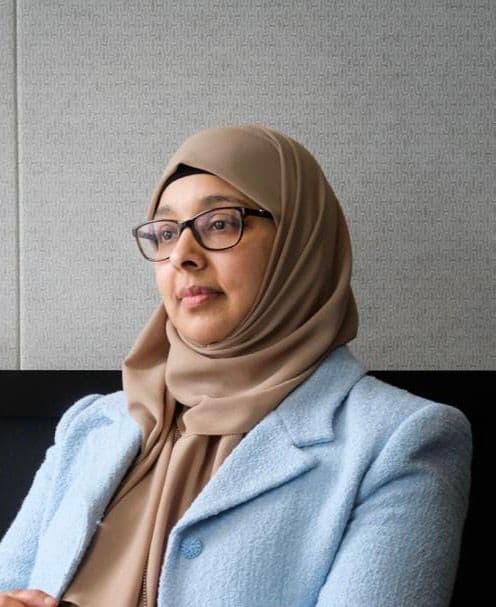
Shaykha Saleha Islam Bukhari is an award-winning Ālimah and Muslim chaplain whose work centres on women’s spiritual presence in sacred spaces. Based in Canary Wharf, she works across scholarship, chaplaincy, and community care. After many years devoted to family life, she returned to formal study, completing the Ālimiyyah programme and receiving ijāzah in Qur’an recitation and Sahīh al-Bukhārī. She currently serves with Islamic Relief and the Muslim Law (Shariah) Council UK, and co-hosts Islam Channel’s IslamiQA.
Introduction
Some people rebuild spaces: others restore the spirit that lives inside them.
Shaykha Saleha Islam works in this quieter register, with a presence that reshapes a room without altering a single brick.
Her journey into Islamic scholarship came later in life, following an eighteen-year career break and a persistent desire to return to the depth of her faith. Today, she works as a chaplain and adviser, supporting communities to imagine mosques not only as places of worship, but as environments shaped by care and dignity.
In this conversation for The Chaplaincy Series, we reflect on her return to knowledge, the atmospheres that shaped her, and her vision for mosques that breathe with mercy and balance.
Roots & Return
Saleha speaks about her return to study the way others speak about returning home with gratitude, with relief, and with a sense of inevitability.
“There was always a hunger,” she says. “A quiet ache to understand my faith in a deeper, fuller way. You reach a point where life itself asks you to return.”
After nearly two decades away from formal education, she stepped into a six-year immersion in Islamic sciences and hadith. It was a bold move, one that stitched together her many identities: wife, mother, daughter of immigrants, seeker, and now scholar.
“Returning to study wasn’t reinvention,” she reflects. “It was a remembrance. An uncovering of who I already was.”
That spirit of return thoughtful, steady, sincere runs through everything she does.
Belonging Beyond Bricks
Her earliest memories of mosques carry both longing and possibility.
Growing up in Britain’s first-generation communities, mosques were often improvised spaces, shaped by necessity rather than intention. “They were homes from home,” she says, “but rarely places that imagined women at the centre.”
By the age of eleven, she sensed the quiet exclusions: side entrances, partial participation, a feeling of being present but unseen. Alongside this, she also witnessed change — mosques opening their doors more widely, expanding women’s spaces, and offering programmes that reflected the needs of families and younger generations.
“Islam is rooted in justice and the preservation of humanity,” she says. “Our mosques must reflect that consistently.”
For her, belonging has become something practised rather than assumed. It lives in softened rooms, in moments of stillness after prayer, and in a closeness to Allah that anchors her to others.
Holding Space — Chaplaincy as Care
If scholarship is her foundation, chaplaincy is her craft. As the Canary Wharf Chaplain, her work unfolds in the spaces between hurried footsteps and reflective pauses. Glass towers and prayer rooms.Conversations that begin with a question and end with a softened breath.
“Chaplaincy is spatial compassion,” she says. “It is holding space for others without judgement, without hurry. Care is foundational architecture.” Her advisory work on multi-faith prayer rooms echoes the same ethos: light that calms, sound that doesn’t overwhelm, privacy that protects dignity. She believes that the way a space makes you feel is as important as how it functions.
Her guiding verse comes from Surah al-Ma’idah: “Whoever saves one life, it is as if they saved all of humanity.”
“It reminds me,” she says, “that changing one person’s world is meaningful. That presence can be profound.”
Women’s Presence & Spiritual Agency
There is a different kind of scholarship in noticing what is missing. For Saleha, women’s visibility in mosques has always been both a personal and communal concern shaped by moments of exclusion and by glimpses of what is possible.
“I’ve been told ‘we don’t accommodate women’ more than once,” she shares, not with bitterness but with resolve. “But I’ve also seen what happens when women lead, speak, teach, and shape the space.”
She has delivered workshops on “Creating Space for Women in the Mosque” and mentored women stepping into leadership roles. Her work emphasises that mosques must be more than lecture halls; they must be lifelines: places where mothers, young professionals, elders, and converts find grounding. “Women’s leadership isn’t decorative,” she says. “It is essential. It widens the atmosphere of the mosque.”
Designing for Dignity
Saleha speaks about mosque design through the language of atmosphere rather than architecture. It’s not the geometry that moves her, it's the way a space breathes. She draws inspiration from the maristans of Granada historic healing spaces where water, gardens, courtyards, and worship coexisted. “Those buildings still stand because they were designed with purpose and compassion,” she says. “They understood that care is not separate from the sacred.”
When she imagines a mosque, she imagines light that softens the heart, textures that ground the body, and sound that doesn’t drown the spirit.
“All five senses,” she says, “are a form of worship when used well.”
Design, for her, begins with one principle: Treat people the way they want to be treated. Everything else follows.
A Vision for the Future
When asked what future she hopes her work helps imagine, she pauses then speaks with gentle certainty.
“A future where women feel elevated and confident in sacred spaces. A future where our imams are supported and not stretched thin. A future where mosques feel open, lived-in, and welcoming to Muslims and non-Muslims alike.”
Imagination, she believes, is a form of devotion. It carries heritage forward not through nostalgia but through possibility. “What we design,” she says, “must help our communities breathe.”
Her guiding principle this month is simple: non-judgement. An openness that allows people with all their complexity to arrive as themselves.
Photo by Ameena Rojee for Hyphen Online.
Contributors
Shaykha Saleha Islam Bukhari
Chaplaint
About the Author
Ikram Hirse
Founder of Mimbar360
Ikram Hirse is a social entrepreneurship based in the UK.
Gallery